“We all, with unveiled face, beholding the glory of the Lord, are being transformed into the same image from one degree of glory to another. For this comes from the Lord who is the Spirit.”
2 Corinthians 3:18
That single verse quietly dismantles the myth that sanctification is about moral self-improvement or spiritual performance. It is not. It is about exposure—beholding—and about the slow, faithful work of God over time.
Scripture tells us plainly that transformation is not instant, nor is it self-directed. It is the work of the Holy Spirit of God within us as we live out our lives day by day, struggle by struggle, victory by victory.
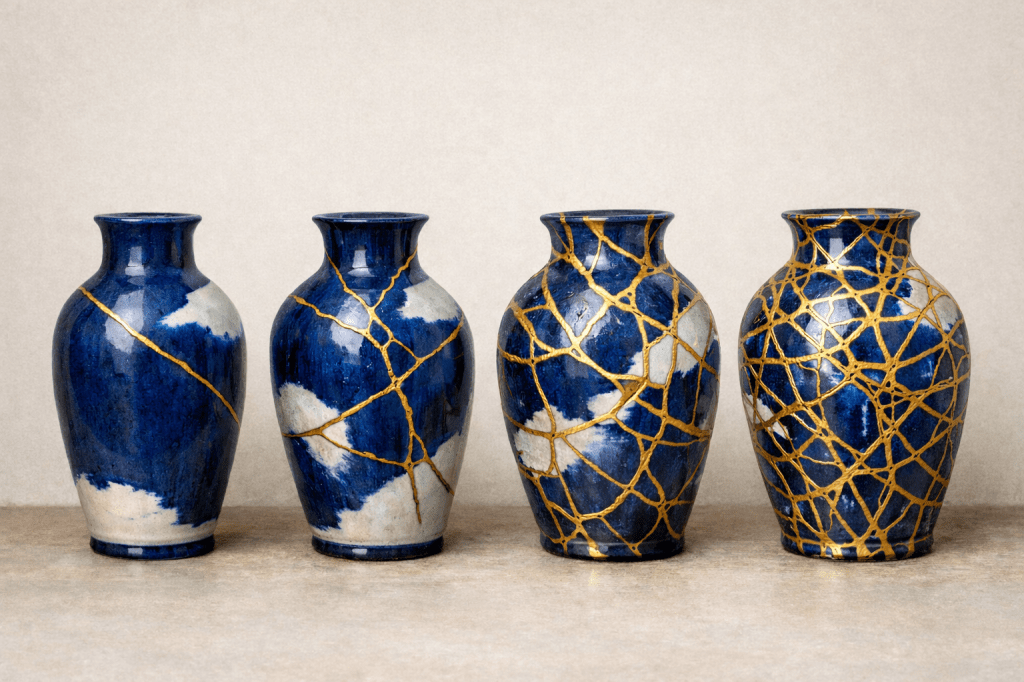
There is a Japanese art form called kintsugi. When a piece of pottery is broken, it is not discarded or hidden. Instead, the cracks are filled with gold. The fractures are not erased; they are honored. The vessel is made whole again—not by returning to what it once was, but by becoming something new, something stronger, something more beautiful because it has been broken.
This image came to me on my way to church last Sunday as I was reflecting on how God uses the things that happen to us to transform us.
Brokenness Is Not the Obstacle
We can be tempted to assume that our trials, losses, suffering, and failures are just pointless pain or meaningless interruptions to our lives. But Scripture presents them as instruments of spiritual growth.
God does not wait for us to be intact before He begins His work. He works precisely through what is fractured.
Trials strip away self-reliance.
Loss loosens our grip on what was never eternal.
Waiting exposes our impatience and our idols.
Obedience stretches us beyond our strength.
Suffering reveals where our hope has quietly rested on something other than God.
These experiences break us open—not to destroy us, but to expose us.
And exposure is where sanctification begins.
Gold in the Cracks
In kintsugi, the gold does not replace the pottery; it fills what is missing. In the same way, sanctification is not the erasure of our humanity, but the gradual displacement of sinful flesh as the life of Christ increasingly takes root within us.
God does not pretend we were never broken.
He redeems the breaking.
Where pride once lived, humility takes root.
Where fear ruled, trust slowly grows.
Where self-sufficiency reigned, dependence on God becomes natural.
Over time—often unnoticed by us—Christ fills the cracks.
“It is no longer I who live, but Christ who lives in me.”
Galatians 2:20
This is not metaphorical language meant to inspire. It is a spiritual reality.
Sanctification Is a Process, Not an Event
Kintsugi is painstaking work. It cannot be rushed. The artisan must handle the vessel gently, patiently, deliberately.
God is not in a hurry with us either.
Scripture never promises instant sanctification. It promises faithful completion.
“He who began a good work in you will bring it to completion at the day of Jesus Christ.”
Philippians 1:6
Until resurrection, the process continues.
There will always be another crack to fill.
Another temptation to overcome.
Another heartbreak, disappointment, or loss to heal.
Another attachment to surrender.
Another layer of self to relinquish.
And that is not failure—it is evidence that God is still at work.
Becoming More Gold
If we are surrendered—if we are walking by faith, not by sight—then over the course of a lifetime, something remarkable happens.
There is less frantic striving.
Less need to be right, seen, defended.
Less flesh-driven reaction.
And more peace.
More patience.
More love that costs us something.
Not because we are becoming less human, but because we are becoming more like Christ.
The vessel does not disappear.
But the gold becomes more visible.
“Though our outer self is wasting away, our inner self is being renewed day by day.”
2 Corinthians 4:16
The End Toward Which We Are Moving
Kintsugi vessels are never returned to their original state. Neither are we.
God is not restoring us to who we were before we were broken.
He is preparing us for who we will be when we are made whole.
That work will not be finished in this life.
Sanctification ends only at resurrection—when what is now partial is made complete, when faith becomes sight, and when every fracture is finally filled with glory.
Until then, we surrender.
We obey.
We wait.
We trust.
And God, according to His divine plan, faithfully fills the cracks with gold.



 a surrendered life